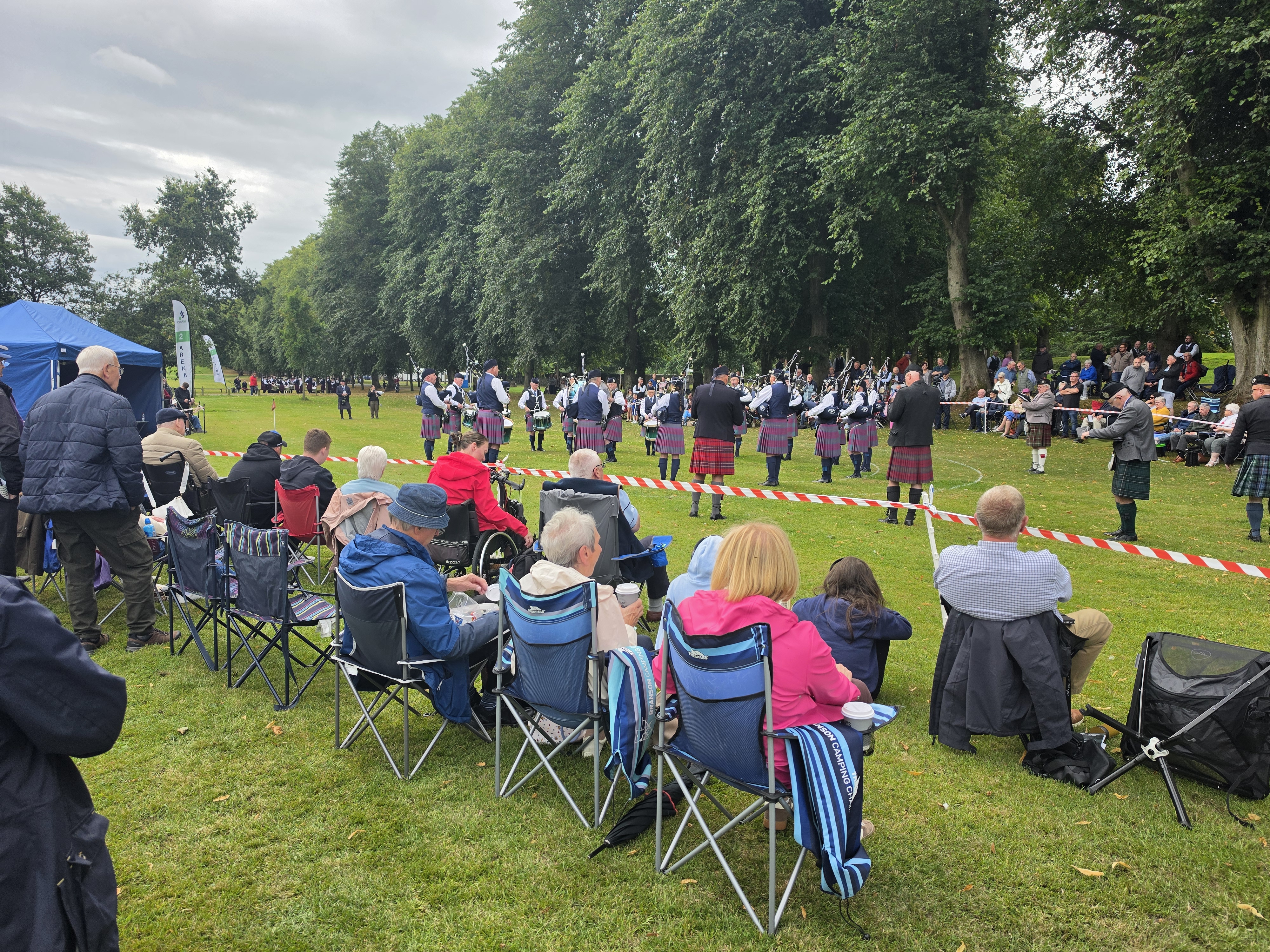
Not many people know this about me, but I have played in a pipe band for over 40 years.
It has been a huge part of my life. I have brilliant memories of competing, winning major competitions, travelling overseas with the band and, most importantly, the friendships and experiences that came with it.
I am still involved in the band today, although we don’t compete in the way we did in former years. So, after being away from pipe band competitions for a while, it was great to get back to a local event and experience it again.
And, as often happens with me when I attend any event, I found myself looking at it through two lenses: as a pipe band person who loves the culture, but also as someone who works in sport and thinks a lot about events, participation and the fan experience.
There was plenty that impressed me – but it also got me thinking about some challenges that pipe bands and sport actually have in common.
1. Make the most of the space you have
One of the first things that impressed me was the use of the park for car parking. Simple, but effective. There was space available and the organisers used it well.
What can sport learn?
We sometimes immediately think that improving an event requires significant investment. It doesn’t always. Look at the assets you already have – car parks, green spaces, clubhouses, unused areas around venues – and ask how they can improve the experience or potentially generate additional income.
2. Never underestimate the importance of volunteers
There were a good number of volunteers helping throughout the event – managing the car parking, moving bands forward and generally keeping everything running.
The event flowed really well. Bands kept coming into the arenas, performing their pieces and moving on.
That doesn’t happen by accident.
What can sport learn?
Volunteers remain the lifeblood of so many sports, clubs and community events. But we need to look after them. Recruit them properly, give them clearly defined roles, train them, communicate with them and, importantly, recognise them.
A good volunteer programme can make an enormous difference to the experience of everyone attending an event.
3. Promotion needs to go beyond the people who already know you
This was probably my biggest observation.
From what I could see, promotion was mainly through the council’s Facebook page and pipe band-related websites and channels.
There is nothing wrong with that – if your target market is people who already follow pipe bands.
But how do you attract everyone else?
This is a challenge I see regularly in sport. We promote our events through our own social media channels, websites and databases and then wonder why we continue to attract largely the same audience.
What can sport learn?
Start with the audience you want to attract rather than the communication channel you want to use.
If you want families, young people, tourists or people who have never attended before, identify where they are and give them a reason to come.
Don’t simply promote what the event is. Promote why someone should spend their Saturday afternoon there.
4. Free entry can be a powerful strategy – but think about the wider commercial model
I was pleasantly surprised that admission was free, apart from car parking.
It appeared that income opportunities included council support, car parking, food concessions and programme sales.
Free admission removes one of the biggest barriers to trying something for the first time.
What can sport learn?
Ticket income doesn’t always have to be the starting point.
Could free or low-cost entry increase attendance and create more income elsewhere through food and beverage, merchandise, sponsorship, hospitality, parking or other activities?
Sometimes getting another 1,000 people through the gate creates more long-term value than maximising the price paid by the existing audience.
5. Don’t design your event only for your existing fans
The event felt very much aimed at people who already understood and enjoyed pipe bands.
As a pipe band person, that was fine for me.
But what if you weren’t?
This is where I think there is a real opportunity.
What can sport learn?
When planning an event, think about three audiences: your committed fan, your occasional fan and someone who knows almost nothing about what you do.
Would all three enjoy the experience?
Explain what is happening. Tell the stories. Introduce the personalities. Create activities around the main event. Give newcomers an accessible way into your sport or culture.
We shouldn’t assume everyone understands our world.
6. Location matters
The crowd was relatively limited, and I couldn’t help thinking about whether bringing the event closer to – or even into – the town centre could help.
People who hadn’t planned to attend could hear the music, see what was happening and decide to come along.
What can sport learn?
Sometimes we ask people to come to the event. Could we instead bring the event to the people?
Fan zones, demonstration events, town-centre activities, pop-up participation opportunities and community activations can all expose a sport to audiences who would never deliberately travel to a traditional venue.
Visibility matters.
7. Give people more reasons to stay
Apart from watching the bands, there wasn’t a huge amount to do.
Again, if you love pipe bands, that’s absolutely fine.
But imagine developing a wider cultural festival around the competition – live Ulster-Scots music, dancing, children’s activities, opportunities to try the pipes or drums, storytelling, local history, food and perhaps performances between competition sections.
Suddenly, you are potentially appealing to a much wider audience.
What can sport learn?
The competition might be the centrepiece, but it doesn’t have to be the entire experience.
Think about entertainment, music, participation zones, children’s activities, food, sponsor activations and opportunities to learn about the sport.
Turn a two-hour match or competition into a half-day experience.
8. Where is the next generation?
This was probably the point that concerned me most.
Looking around those watching the bands, there were families and children, but the audience definitely felt more weighted towards an older generation.
It made me ask a fairly simple question:
What happens in 20 years’ time?
Culture is incredibly important to society. But culture only survives if the next generation connects with it.
Sport faces exactly the same challenge.
What can sport learn?
We cannot assume that because previous generations supported our club, sport or event, the next generation automatically will.
Young people have more entertainment choices than ever before.
We need to understand them. Ask what they want. Involve them in designing events. Create experiences they want to share. Bring the sport into schools and communities. Make it social and welcoming.
Most importantly, start building the next generation of participants, volunteers and fans now, rather than when attendances begin to fall.
9. Food and beverage is part of the experience
There were three main food options – donuts, a chip van and coffee – which was probably appropriate for the size of the crowd.
And I have to say, the burger I had was actually very good!
What can sport learn?
Food and beverage shouldn’t simply be viewed as something we have to provide.
It is part of the customer experience and potentially an important revenue stream.
Look at quality, choice, pricing, queues, local suppliers and how food can actually add something distinctive to the event.
10. Good organisation still matters
One thing that shouldn’t be overlooked was how smoothly the actual competition appeared to operate.
Bands were continually being moved forward, entering the arenas, competing and making way for the next band.
That requires organisation, communication and good volunteers.
What can sport learn?
We can talk about fan engagement, entertainment, marketing and commercialisation, but the core event still has to work.
Good scheduling, clear signage, knowledgeable volunteers, communication and operational planning are fundamental to a positive experience.
The bigger question
I really enjoyed being back.
There was a lovely atmosphere, I enjoyed hearing the bands again and it reminded me how important pipe band culture has been in my own life.
It is also obvious that many of these events operate with limited budgets and depend enormously on volunteers who are giving their time because they care passionately about keeping the tradition alive. They deserve huge credit for that.
But I couldn’t stop thinking about one question:
How do we attract people from outside the pipe band world?
And perhaps that is the question many sports should be asking themselves too.
We can become very good at organising events for the people who already love us.
The bigger challenge is creating an experience that makes someone who has never attended before think:
“I’d like to go to that.”
For pipe bands, sports clubs, leagues and governing bodies, that may be one of the most important challenges for the next 20 years.
Because whether it is sport or culture, we can’t simply protect what we have.
We have to make the next generation want to be part of it.
About Geoff Wilson
Geoff runs his own consultancy business, with a focus primarily on sport. Previously Head of Marketing and Communications at the Irish FA, Geoff now consults to a wide range of global sports organisations on areas such as strategic planning, marketing and communications, digital, fan engagement, public affairs, women’s football, league development, club development and knowledge sharing / capacity building programmes. Geoff has created numerous academic models for the sports industry. Geoff is on the Advisory Panel at the English Football League and Chair of the Sports Council Trust Company (Sport England organisation).
Geoff has written a book which focuses on ‘developing grassroots sports clubs’ to order a copy check out https://www.routledge.com/Leading-a-Grassroots-Sports-Club-A-Practical-Guide-to-Managing-and-Developing-Your-Club/Wilson/p/book/9781041094883?srsltid=AfmBOooMPgFpXYSGYwNBOLxrR6mYShU8mWeM_rbVCGlipdpjnsfqlqVD
1. Check out Geoff’s online course in strategic planning at https://geoffwilson.teachable.com/
2. The other sports models created or co created by Geoff can be found below:
- Fan engagement https://geoffwnjwilson.com/2016/08/25/254/
- Fans Journey Model https://geoffwnjwilson.com/2023/04/06/the-fan-journey-model/
- Club Development framework model https://geoffwnjwilson.com/2024/01/30/club-development-framework-model-for-the-sports-industry/
- Growing attendance https://geoffwnjwilson.com/2019/09/18/growing-attendance-model-gam/
- Data maturity on sport https://geoffwnjwilson.com/2021/05/29/61-of-all-sports-organisations-do-not-use-data-for-their-overall-strategy/
- Sports Community Engagement Model https://geoffwnjwilson.com/2024/08/22/sports-community-engagement-model/

